
Cruises are one of the toughest constellations for mobile internet: for hours the ship is out of reach of any cell tower, then briefly in port in a foreign mobile market, then back open at sea. Leave data roaming on without a thought and a Mediterranean or Caribbean tour can run up a four-figure phone bill. A travel eSIM doesn't magically solve the problem — but it's an important building block of the right strategy. Here's the complete guide to onboard mobile, ship Wi-Fi via Starlink and which eSIM plans actually pay off for which cruise region.
How does mobile work on the open sea?
As soon as a ship reaches roughly 12 nautical miles from shore, the crew techs switch on the maritime onboard network. The market leader is Cellular at Sea (CaS), an AT&T subsidiary; in Europe Telenor Maritime (formerly MCP / Maritime Communications Partner) competes. Both run small pico cells onboard that hand off the smartphone signal to fixed-line infrastructure via satellite backhaul.
On your phone the network shows up as "Cellular at Sea" or "Telenor Maritime", often with PLMN ID 901-12 (Telenor Maritime, international MCC 901 for "non-country-specific") or similar 901 codes for CaS. While the ship is in port or hugging the coast the phone usually latches onto the local network — only on the open sea does the onboard network take over.
Starlink onboard — the game-changer since 2022
Until 2022, onboard Wi-Fi was slow and expensive. With the rollout of Starlink Maritime that has fundamentally changed. Today, realistic speeds of 50–150 Mbit/s are achievable even mid-Atlantic — usable for streaming and video calls for the first time.
| Cruise line | Starlink status 2026 | Daily price (onboard) |
|---|---|---|
| Royal Caribbean | First major customer 2022, VOOM packages fleet-wide via Starlink | VOOM Surf+Stream USD 19.99/day |
| Carnival Corporation (Carnival, Holland America, Princess, Seabourn, Cunard, Costa, AIDA, P&O) | 100 % of fleet since May 2024 | AIDA: €1/€5/€10/€15 tier packages |
| MSC Cruises | Fleet-wide migrated | Tier packages depending on voyage |
| TUI Cruises Mein Schiff | Since 2025, surcharge for long-haul destinations dropped | SurfLight 1 GB €15, SurfMax week €175 |
| Hurtigruten, Ponant, expedition lines | Upgrading, often slower — check per ship | Variable, often more expensive per GB |
Three strategies for mobile internet on cruises
There are three sensible approaches — and any combination of them. Which fits you depends on the line, the route and your data needs.
Travel eSIM only for port days
RecommendedOne travel eSIM for each region. When docking, the phone switches automatically to the local network and the eSIM takes over. At sea: data roaming completely off, use ship Wi-Fi or stay offline.
- Cheap (€5–16 for a Mediterranean tour)
- Zero roaming risk
- Full speed in port
- Offline on sea days
- May need to pay extra for ship Wi-Fi
Multi-country regional eSIM
ComfortIdeal for Mediterranean tours: Airalo Eurolink, Holafly Europe or Saily Europe cover all EU ports in one plan. For the Caribbean there are regional packs (e.g. GigSky, Simsolo, eSimpli) covering 24–37 islands.
- One eSIM for the whole trip
- No QR-code swapping in port
- Also works for multi-country tours
- Slightly more expensive per GB than single-country
- Also offline on sea days
Ship Wi-Fi only
Heavy userWith Starlink-equipped lines, onboard Wi-Fi actually works well (50–150 Mbit/s per Cruise Critic). Data roaming on the phone stays fully off, all online activity runs over the ship's Wi-Fi — even in port if the ship continues using Starlink there.
- Zero roaming risk
- One plan for the whole trip
- Fast enough for streaming
- Pricey: €70/week AIDA flat vs. €16 Eurolink eSIM
- Only sensible on Starlink ships
- Special cruise eSIMs (GigSky) rarely worth it
How to safely disable maritime roaming
As soon as the local network gets weaker, your phone automatically searches for a new network — and finds the onboard network. Without preconfiguration the meter starts running. Here's the safe configuration:
Top cruise routes from a German traveler's perspective

Western Mediterranean (Italy, Spain, France, Malta): entirely EU — the EU "Roam like at home" rule applies in every port, a simple EU eSIM is ideal. Airalo Eurolink or Holafly Europe for €5–10 cover a week easily.

Eastern Mediterranean (Greece, Cyprus, Turkey, Israel): EU ports unproblematic. Watch out for the Turkey stop: the Turkish BTK has blocked the websites and apps of 30+ international eSIM providers (Airalo, Holafly, Saily, Nomad, Ubigi and more) since 2024. If you only try to buy or activate an eSIM once you're on the ship or in a Turkish port, it will fail. Solution: activate the eSIM before the Turkey leg — ideally at home or in the previous EU port via the Wi-Fi there. More details: Turkey eSIM guide.
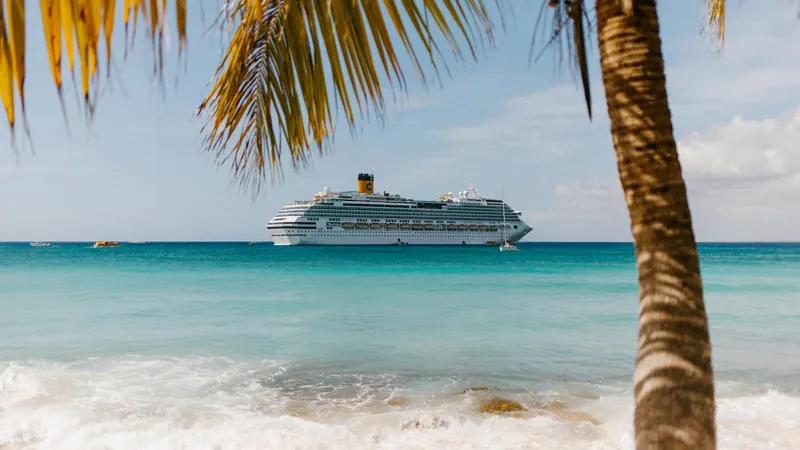
Caribbean (Bahamas, Jamaica, Mexico, Cayman, Dominica, Barbados): every island has its own mobile network with its own roaming rates — a Caribbean regional eSIM is practically the only sensible option here. Providers like Simsolo, GigSky or eSimpli have packs covering 24–37 Caribbean islands in one plan. Airalo also offers Caribbean packs.

Norwegian fjords (Bergen, Geiranger, Tromsø, Lofoten): Norway is in the EEA — the EU "Roam like at home" rule applies normally, EU eSIMs work without surcharge in every port. In summer ships often go far north — Norway's 4G network works along the coast there too.

Canaries / Atlantic islands (Madeira, Azores, Canaries): Madeira and Azores = Portugal, Canaries = Spain — all EU rate. An EU eSIM is enough.

Asia cruises (Singapore, Hong Kong, Vietnam, Thailand): regional eSIMs like Airalo Asialink or Holafly Asia cover the most important ports. Multi-country packs are clearly cheaper here than single-country plans. More in our Asia regions overview.

Antarctic / Arctic expeditions: realistically completely offline — no mobile network on land, very few ports. Ship Wi-Fi via Starlink now works to about 70° N/S, beyond that not guaranteed (not confirmed for current polar stations). For expeditions: rely on ship Wi-Fi, no eSIM needed.
Cruise lines overview: Wi-Fi tariffs in detail
| Cruise line | Wi-Fi plan | Price | Note |
|---|---|---|---|
| AIDA | Onboard Chat | €1/day | Messaging apps only, no browsing |
| AIDA | Social-media flat | €5/day | Instagram, Facebook, WhatsApp |
| AIDA | Internet flat | €10/day | Browsing + email |
| AIDA | Premium Internet flat | €15/day | Streaming + video calls |
| TUI Mein Schiff | SurfLight (1 GB) | €15 one-off | Occasional use |
| TUI Mein Schiff | SurfMax weekly flat | €175/week | 1 device, unlimited |
| Royal Caribbean | VOOM Surf+Stream | USD 19.99/day | Pre-booking via Cruise Planner cheaper |
Cruise eSIMs in practice — what actually works
Straight to the point: maritime eSIMs like GigSky Cruise are a niche — not sensible for every cruiser. Here's the honest take as of May 2026, based on Trustpilot reviews (1,200+ reviews, GigSky currently 4.1 of 5), Cruise Critic forums and real ship coverage.
What's the tech behind it?
GigSky Cruise uses two maritime networks in parallel: Cellular at Sea (Wireless Maritime Services) with around 200+ ships across 25+ lines plus Telenor Maritime with about 150+ cruise ships and ferries. Which network you see onboard depends on the specific ship. In total GigSky covers around 290+ vessels. Roaming deal: Telenor Maritime has partnered directly with AT&T since April 2024 — that improves rate compatibility for US-based travel eSIMs (including GigSky).
Concrete GigSky cruise prices (status 2026)
GigSky's Cruise+Land plans (also valid in port, not just at sea):
| Plan | Price | Enough for |
|---|---|---|
| 1 GB / 7 days | ~€35 | Week-long cruise with messaging and maps only |
| 3 GB / 15 days | ~€52 | 2-week tour with standard usage |
| 5 GB / 30 days | ~€73 | Longer tour, moderate usage |
| 10 GB / 30 days | ~€115 | Heavy user, family |
Effective price: 15–35 cents per MB — compared with carrier pay-per-use roaming (often USD 2–3 per MB) a fraction, but no bargain. A 5-GB Eurolink eSIM for the port days costs around €16. The GigSky Cruise option costs 4× that, but works on sea days too.
Sample calculation: 7-day Mediterranean AIDA cruise
Concretely to the math — Mediterranean cruise with AIDA, Starlink onboard (fleet-wide since 2024):
| Strategy | Cost | Verdict |
|---|---|---|
| AIDA Internet flat 7×€10 | €70 (or €52 early-bird) | Fast enough for streaming via Starlink — everything included |
| GigSky Cruise+Land 1 GB | ~€35 | Only 1 GB for 7 days, slow, no streaming |
| Eurolink eSIM for ports + onboard network off | ~€16 (eSIM) | Cheapest variant — but offline on sea days |
| Eurolink eSIM + Starlink day pass ad-hoc | ~€46 | Best balance: ports via eSIM, sea days via ship Wi-Fi |
Where cruise eSIMs do NOT work
Alternatives 2026
Maritime eSIMs aren't the only option:
- Starlink onboard Wi-Fi: Royal Caribbean, Carnival (incl. AIDA), MSC, Princess, TUI Mein Schiff are now fleet-wide. 50–150 Mbit/s, €20–33/day. Clearly superior for heavy users.
- Red Bull Mobile eSIM: has integrated Telenor Maritime roaming since June 2024 — for Telenor-equipped ships often cheaper than GigSky. A direct competitor for European cruise routes.
- Port eSIM (Airalo/Holafly Eurolink) + onboard Wi-Fi day pass for sea days only: often the cheapest combo for the Mediterranean and Caribbean.
- AT&T Cruise Day Pass / Verizon Cruise Daily Pass (around USD 20/day each) — only worthwhile if you already have a US carrier contract.
Real recommendations by user type
| User type | Recommendation | Why |
|---|---|---|
| Light user (WhatsApp + maps in port, otherwise offline) | Port eSIM (Airalo Eurolink ~€5/GB), deliberately offline at sea | Saves €50–70, no comfort loss |
| Standard tourist (some internet on sea days, no streaming) | Onboard Starlink flat if the ship has Starlink. Otherwise GigSky 1–3 GB | Starlink is now often cheaper than GigSky per GB |
| Heavy user / streaming / business | Onboard Starlink Premium has no real alternative | GigSky is technically too slow, regardless of pack size |
| Polar / expedition / small line | Ship Wi-Fi — GigSky usually doesn't work there | WMS and Telenor are not installed |
Pre-boarding checklist
- Does my ship have Starlink? — check the cruise line FAQ (as of 2026 almost all majors)
- Which maritime network does the ship use (WMS / Telenor)? With Telenor, Red Bull Mobile is often cheaper than GigSky
- Check the route: polar/expedition/small lines → forget GigSky, use ship Wi-Fi
- Phone eSIM-capable? iPhone XS+, Pixel 3+, Samsung Galaxy S20+
- eSIM activation: install just before boarding (or in port on departure day) — otherwise validity starts during the journey
Common questions about eSIMs on cruises
Will my home phone SIM work on a cruise?
Yes — but it gets very expensive at sea. Once the ship is roughly 12 nautical miles from shore, the crew switches on the maritime onboard network (Cellular at Sea or Telenor Maritime). Your phone latches on automatically unless data roaming is turned off. Maritime roaming is not covered by the EU "Roam like at home" rule — typical costs are €15–40 per MB and €2–5 per voice minute. A single WhatsApp voice note can cost double digits, an Instagram reel triple digits. The silver lining: Germany's €50 data cost cap has applied at sea since 2022 — the carrier must cut the connection before another €50 of data charges accrue. Voice and SMS are not affected.
How do I safely disable maritime roaming?
iOS: Settings → Cellular → pick the eSIM/SIM → Data Options → Data Roaming OFF. On iPhones with a separate voice-roaming option, disable that too. Android: Settings → Connections → Mobile Networks → Data Roaming OFF + disable automatic network selection. Safest variant: at sea, switch to airplane mode and re-enable Wi-Fi separately — that lets you use the ship's Wi-Fi without any roaming risk.
Is a travel eSIM worth it for a cruise?
Yes — definitely for the port days. The moment the ship docks, your phone latches onto the local network. With a suitable travel eSIM (Airalo, Holafly, Saily, Simbye) you have cheap data for maps, tour bookings, restaurant search and social media. At sea the eSIM is no help — only the ship's Wi-Fi or offline mode work there. Strategy: a multi-country regional eSIM (e.g. Airalo Eurolink for Mediterranean tours) is usually cheaper and more convenient than buying a new eSIM in every port.
Which cruise lines have Starlink Wi-Fi onboard?
As of 2026, Starlink Maritime is rolled out almost everywhere: Royal Caribbean (since 2022), Carnival Corporation completely since May 2024 (covering Carnival, Holland America, Princess, Seabourn, Cunard, Costa, AIDA and P&O), MSC Cruises fleet-wide, TUI Cruises Mein Schiff since 2025. Hurtigruten, Ponant and smaller expedition lines are upgrading too, often more slowly and without a fleet-wide guarantee. Check the specific ship before booking. With Starlink, realistic onboard speeds of 50–150 Mbit/s are achievable — usable for streaming and video calls for the first time.
What does ship Wi-Fi typically cost?
Onboard daily prices in 2026: AIDA Onboard Chat €1/day, social-media flat €5/day, Internet flat €10/day, premium Internet flat €15/day. TUI Mein Schiff SurfLight (1 GB) €15 one-off, SurfMax weekly flat €175/week for 1 device. Royal Caribbean VOOM Surf+Stream USD 19.99/day (often cheaper when pre-booked via Cruise Planner). Pre-booking via the Cruise Planner portal typically saves 20–30 % versus onboard rates.
Can I activate an eSIM only after I'm onboard?
Not reliably. Most eSIMs need an internet connection for the initial activation, some additionally an SMS OTP. Recommendation: always activate the eSIM before you travel — at home on Wi-Fi or at the airport. Onboard you only have ship Wi-Fi, and whether the eSIM provider's activation servers are reachable through the maritime network is not guaranteed. Activating in port on departure day (before boarding) is also a safe option.
How much data do I need for a 7-day Mediterranean cruise?
Per port day, plan realistically with 200–500 MB for maps, translator, tour bookings, social media and the occasional stream. A 7-day Mediterranean tour with 5 port stops adds up to roughly 2–3 GB for the ports. A 5-GB regional eSIM easily covers that, with reserve for longer tours or more streaming. If you're also very active with video or hotspot in port, plan for 7–10 GB.
What do I need to watch out for on a Turkey port stop?
Important: The Turkish BTK (telecom regulator) has been blocking the websites and apps of 30+ international eSIM providers (Airalo, Holafly, Saily, Nomad, Ubigi and more) since 2024. If you only try to buy or activate an eSIM once you're on the ship or in a Turkish port, it will fail. Solution: activate the eSIM before the Turkey leg — ideally at home or in the previous EU port via the Wi-Fi there. Turkey's notorious 120-day IMEI block, by the way, only affects Turkish local SIMs in foreign devices and is irrelevant for cruisers using a foreign-issued eSIM.